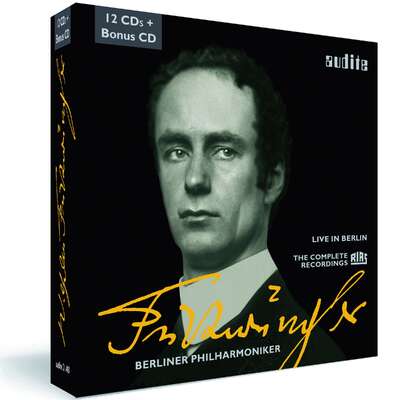
This box contains all of Furtwängler's recordings for the RIAS in the period 1947-54. They have been around for some time, both officially (on DG) in some cases, and on various "pirate" labels such as Tahra, Music and Arts, and others. This latest reissue purports to be the first using the original tapes held in the German Radio archives, and in many instances the improvement is marked. Don't expect miracles though: the Bruckner Eighth, for example, still sounds congested and ill-balanced, but even here Audite has managed to open up the sound to the extent that a greater feeling of depth and naturalness is quite palpable. For Furtwängler collectors this 12-CD set (plus bonus interview with the conductor) clearly is the best option, both on technical grounds and because it's so complete.
As always with this occasionally incandescent but criminally sloppy conductor, there are stunning performances mixed in with a lot of inexcusable technical incompetence. The great moments, including Brahms' Fourth, the amazing December 8, 1952 "Eroica", Hindemith's "Harmony of the World" Symphony, two Schubert Eighths and one Ninth, and the Wagner bits (Siegfried's Funeral Music, the Meistersinger Prelude, and Tristan Prelude and Liebestodt), reveal the conductor at his best: intense, improvisational, completely immersed in the music, and mostly in control of the ensemble. Elsewhere the results range from almost comically ghastly (Brahms' Third, twice, Beethoven's Pastoral Symphony, also twice, Strauss' Don Juan, and some particularly gruesome Bach and Handel) to acceptable or "interesting".
Most frustrating is Beethoven's Fifth, a work that best encapsulates the "Furtwängler problem". His concept of the work is titanic--in both the literal and nautical senses of the word. Anyone can hear what he wants to do. Indeed, I would suggest that much of his cult status stems not from his interpretive subtlety, but from an extreme obviousness that often crosses the line into plain crudeness. Witness the opening of this very symphony, heavily inflected with exaggerated fermatas, in which he seems constitutionally incapable of getting the orchestra to play together. Furtwängler was the ultimate "concept" conductor: he always had one (indeed, it was usually the same one irrespective of repertoire). Unfortunately, as here, he seldom managed to turn his concept into a magnificent performance in real time. That is the true reason his fans collect multiple versions of the same work. Not because of new "insights" (his interpretations hardly varied in any significant way from one performance to the next), but in a sort of noble (because it is doomed) quest for that musical holy grail, a Furtwängler performance in which mostly everything goes right. As with many such exercises in futility, it's the quest that's the point, and not the prospect of success at the end.
So we should not listen to his apologists and overestimate the difficulties he faced. Messing up the opening of Beethoven's Fifth (THE iconic German symphony), with THE major German orchestra--one that knows the music practically by heart--is disgraceful coming from (allegedly) the greatest German conductor of his era. It's "Conducting 101". The conductor's job is not merely to have a great concept--anyone familiar with the music can do that--but to get the orchestra to realize that concept at the highest standard of executional excellence. By this measure, Furtwängler was, at best, a mediocrity.
Of course his fans don't care and will forgive him virtually any lapse, no matter how severe. That's their choice, but let's not demean the term "greatness" by lavishing it on work that was substandard even, as here, back in the early post-war years. I say this not because I'm going to convert anyone to my way of thinking, but as a caution to the curious. These are the best-sounding versions of these performances, so if you've been waiting to take the plunge, this set is certainly the way to go. But listen critically, and don't let the Furtwängler wackos convince you that great conducting is incompatible with clean rhythm, precise ensemble, and great playing.
|