






Add download to your cart
92565 - Es ist ein Ros’ entsprungen – Choir and Organ Christmas Music
aud 92.565
please choose the quality
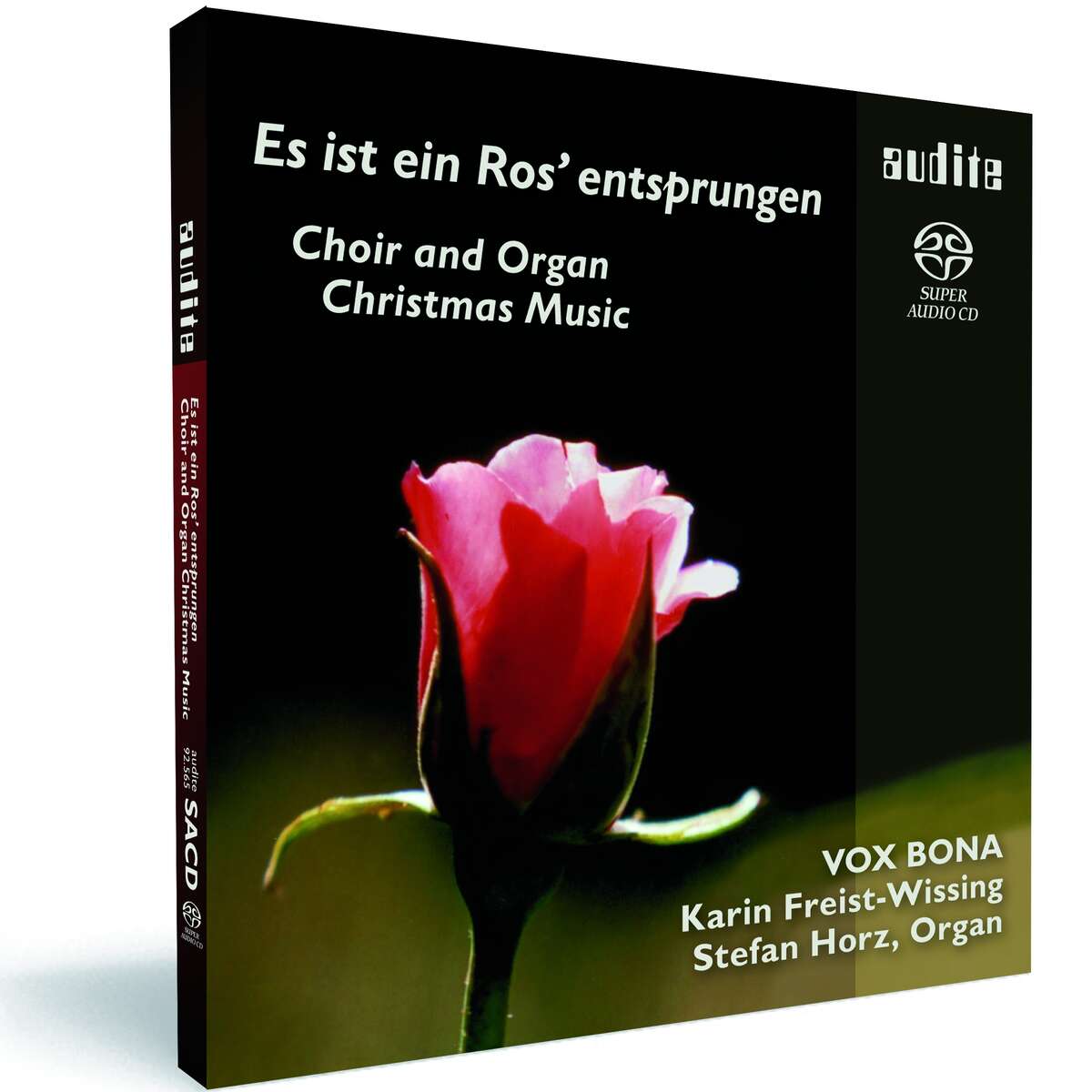
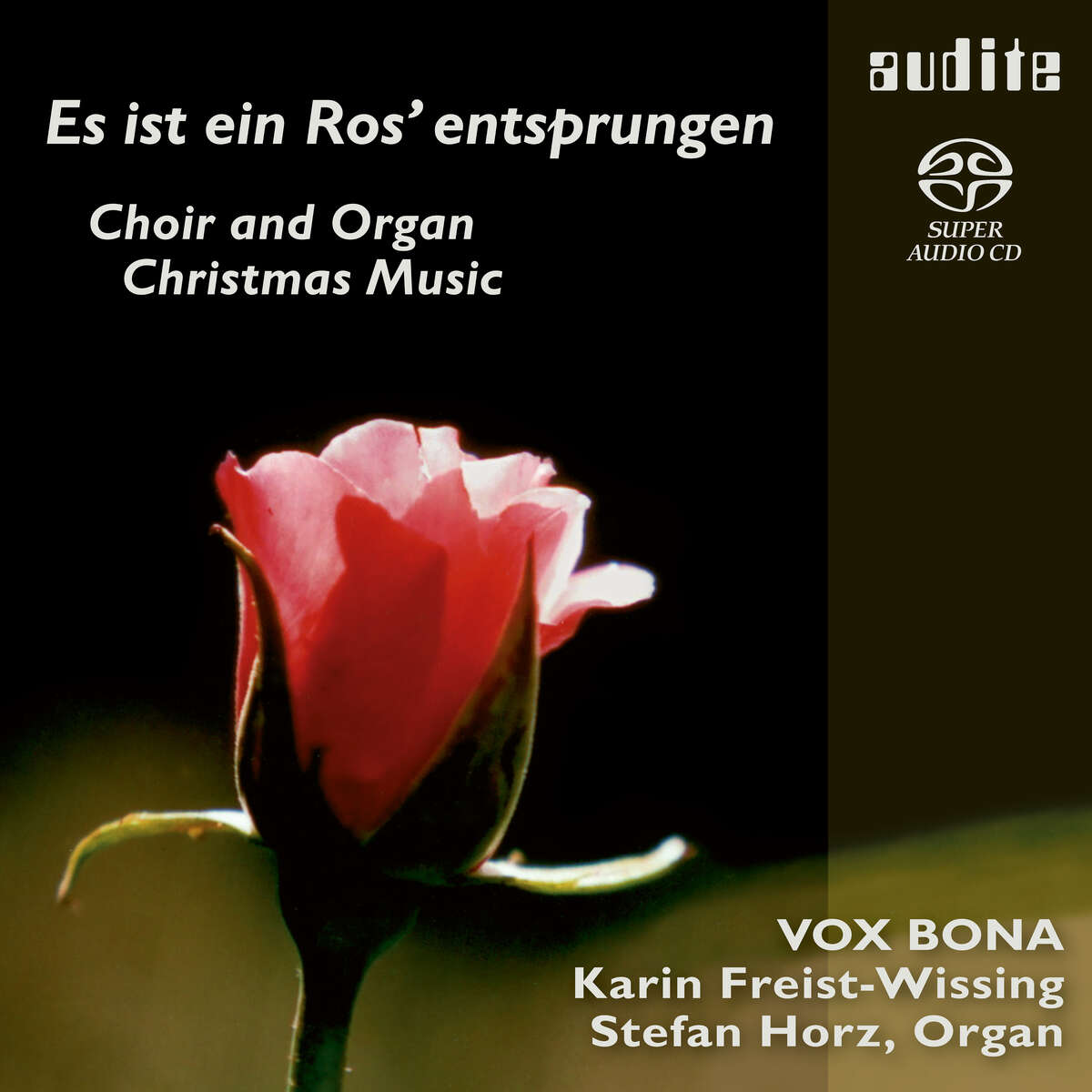
The Vox Bona choir contrasts the noisy and busy exterior of Christmas with the quiet interior: the pictorial contemplation of Jesus’ birth and Mary’s motherhood; the feeling of security until death that is promised to humanity by the Nativity . From the organ piece “Maria zart von edler...more
Michael Praetorius | Heinrich Kaminski | Wolfgang Seifen | Jan Sandström | Max Reger | Morten Lauridsen | Johannes Brahms | Hugo Distler | Arnolt Schlick | Johann Sebastian Bach


"Vox Bona produce a breadth and richness of sound, an ancient timbre, that is just overwhelming. It’s an extraordinary fusion of old and new, a minor masterpiece that deserves the widest possible audience." (musicweb)

Track List
Details
| Es ist ein Ros’ entsprungen – Choir and Organ Christmas Music | |
| article number: | 92.565 |
|---|---|
| EAN barcode: | 4022143925657 |
| price group: | ACX |
| release date: | 30. October 2009 |
| total time: | 80 min. |
Bonus Material
Informationen
The Vox Bona choir contrasts the noisy and busy exterior of Christmas with the quiet interior: the pictorial contemplation of Jesus’ birth and Mary’s motherhood; the feeling of security until death that is promised to humanity by the Nativity. From the organ piece “Maria zart von edler Art” by Arnolt Schlick from 1513 through to the most modern choral compositions by Morten Lauridsen and Wolfgang Seifen; from the famous “Es ist ein Ros’ entsprungen” by Michael Praetorius through to a modern reflection of this piece for choir by Jan Sandström (1990), this music looks towards the interior: it concentrates on the preciousness of the event of the birth, and on its heartfelt contemplation which includes death. The organist Stefan Horz comments on these contemplations with improvisations and works by Bach, Brahms and Reger.
The chamber choir Vox Bona makes its home at the Kreuzkirche Bonn. The choir has acquired a diverse repertoire, ranging from medieval Easter Singspiele and Renaissance music to contemporary music and experimental choral improvisations. The constant progress of the choir is documented not only by its successful concerts and CD releases but also by many awards at national and international competitions. The choir regularly performs with professional orchestras and undertakes many prestigious concert tours in Germany and abroad.
Reviews

Gramophone | December 2010 | Fabrice Fitch | December 1, 2010
A festive feast
Bach! The Herald Angels Sing
Few countries have shaped the experience of Christmas more decisively than Germany and, with one exception, the remainder of these discs are fromMehr lesen
Few countries have shaped the experience of Christmas more decisively than Germany and, with one exception, the remainder of these discs are from German labels and ensembles. A highly enjoyable and off-the-beaten-track pair comes from the label Audite, whose releases are commonly issued in Super Audio format. The all-organ recital by Johannes Strobl on the great organ of the Abbey of Muri consists of music by l8th- and 19th-century South German, Austrian and Bohemian composers of whom I'd never heard. These preludes, pastorellas, pifas and the like, undemanding and undemonstrative as they are, make for instructive listening: the common emphasis on rocking cradle rhythms is a sufficient programme in itself. And let's be honest: no century has, more than the 18th, been confined to such a restricted pantheon of composing figures. It makes a change from Bach ... on which, however, more presently. The second disc, "Es ist ein Ros' entsprungen", fearures the organist Stefan Horz and the vocal ensemble Vox Bona in a wide-ranging programme centred on the famous tune. The choral items, composed in an accessible, modern style, are a mixed bag, but as an enterprising move away from the same old Christmas programming both discs together give a positive, coherent impression of the label's aims.
Few countries have shaped the experience of Christmas more decisively than Germany and, with one exception, the remainder of these discs are from

Frankfurter Allgemeine Zeitung | 23. Dezember 2009 | Christiane Tewinkel | December 23, 2009 Singe, wem Gesang gegeben
Natürlich muss heute Abend gesungen werden. Nichts bietet schönerenMehr lesen
Aus urheberrechtlichen Gründen dürfen wir ihnen diese Rezension leider nicht zeigen!
Natürlich muss heute Abend gesungen werden. Nichts bietet schöneren

Glaube + Heimat - Mitteldeutsche Kirchenzeitung | Nr. 51/52 vom 20. Dezember Weihnachten | Michael Klein | December 20, 2009
Chor- und Orgelmusik: Schon die Beachtung skandinavischer ChorkomponistenMehr lesen
Aus urheberrechtlichen Gründen dürfen wir ihnen diese Rezension leider nicht zeigen!
Chor- und Orgelmusik: Schon die Beachtung skandinavischer Chorkomponisten

Westdeutsche Allgemeine Zeitung | Samstag, 12. Dezember 2009 Nr. 291 | Lars von der Gönna | December 12, 2009
Das ist die CD für alle, deren Weihnacht nicht zwischen Schneespray undMehr lesen
Aus urheberrechtlichen Gründen dürfen wir ihnen diese Rezension leider nicht zeigen!
Das ist die CD für alle, deren Weihnacht nicht zwischen Schneespray und

ouverture Das Klassik-Blog | Samstag, 5. Dezember | reagenz | December 5, 2009
Diese Super Audio CD widmen Karin Freist-Wissing, Leiterin der Chor- undMehr lesen
Aus urheberrechtlichen Gründen dürfen wir ihnen diese Rezension leider nicht zeigen!
Diese Super Audio CD widmen Karin Freist-Wissing, Leiterin der Chor- und
Online Musik Magazin | Dezember 2009 | Stefan Schmöe | December 1, 2009 Verinnerlichte Weihnachtsmusik
„Es ist ein Ros' entsprungen aus einer Wurzel zart“: Das Zarte,Mehr lesen
Aus urheberrechtlichen Gründen dürfen wir ihnen diese Rezension leider nicht zeigen!
„Es ist ein Ros' entsprungen aus einer Wurzel zart“: Das Zarte,

Der neue Merker | 29. Jahrgang - Nr. 47 | Michael Karrass | November 25, 2009
Der lauten, geschäftigen Außenseite des Weihnachtsfestes stellt der ChorMehr lesen
Aus urheberrechtlichen Gründen dürfen wir ihnen diese Rezension leider nicht zeigen!
Der lauten, geschäftigen Außenseite des Weihnachtsfestes stellt der Chor

www.musicweb-international.com | November 2009 | Dan Morgan | November 18, 2009
According to Audite the idea behind this collection is to create ‘a link between the 16th and 21st centuries’; this it certainly does,Mehr lesen
According to Audite the idea behind this collection is to create ‘a link between the 16th and 21st centuries’; this it certainly does, encompassing music from the likes of Michael Praetorius and Morten Lauridsen. But, despite the unifying use of the 16th-century carol Es ist ein Ros’ entsprungen - prosaically rendered as ‘A twig sprang forth’ or, more poetically, as ‘Lo, How a Rose E’er Blooming’ - I did wonder how comfortable these disparate elements would be on the same disc. Also, I couldn’t see the logic of pairing a cappella works and organ improvisations of the same pieces; and, as the Vox Bona choir and organist Stefan Horz are both associated with Bonn’s Kreuzkirche, why are the organ and choral contributions split between two different venues with very different acoustics?
Enough cavilling, what about the music? The German composer Michael Praetorius is credited with the first proper setting of Es ist ein Ros’ entsprungen in his Musae Sionae of 1609. The choir sing with astonishing clarity and focus right across the range, but there’s not much sense of a church acoustic here. With nary a pause we are plunged into Horz’s organ improvisation, which sounds rather bland compared with those of formidable French improvisers such as Marcel Dupré and Thierry Escaich. Traffic noises - always a problem when recording in public buildings - are very audible in the quieter, more sustained passages.
The 19th-century carol Maria durch ein Dornwald ging (‘Mary walked amid the thorns’) is sung here in a setting by Heinrich Kaminski, whose professorship at the Prussian Academy of Arts in Berlin in the 1930s was cut short by revelations of his Jewish ancestry. Now this sounds more like a church acoustic, with a greater sense of space and a pleasing ‘ring’ to the voices. Again, Horz’s contribution cuts in too soon, but this time it’s much more engaging than his earlier effort. Indeed, the music ‘flowers’ rather beautifully in the organ’s higher registers, with warm, sustained pedals below.
The contemporary German composer and organist Wolfgang Seifen’s setting of Die Nacht ist vorgedrungen (‘The night is nearly over’) also has unhappy connections with the Third Reich; the original carol was penned by Jochen Klepper in 1937, just five years before Nazi persecution drove him and his family to commit suicide. It’s not a carol I know, so texts and translations would have been very useful here. That said, I soon found them via Google, and what a moving, albeit rather sombre, view of our redemption from ‘guilt and pain’. Vox Bona sing it with a passion and feeling I’ve not heard thus far, Karin Freist-Wissing coaxing beautiful, well-blended sounds from her choir. Not uplifting in the traditional sense, perhaps, but for all that Seifen finds a dark radiance here that is utterly compelling. After music of such sustained intensity Horz’s Messiaen-like improvisation could only be a let-down - and it is.
Moving north to Sweden, we have Gloria, Jan Sandström’s hymn to the Mother of God. It’s a multi-faceted work, with ethereal solos rising from the body of the choir and the singers dividing to create antiphonal effects. In feeling it reminds me of Knut Nystedt’s Salve Regina, surely one of the most beautiful Marian settings around. This is first-rate singing, varied, virtuosic and, above all, deeply felt. The mood is spoilt by a rather tremulous start to Max Reger’s Ave Maria. A hymn to Mary it may be, but that’s not enough to warrant the latter’s proximity - cheek by jowl, as it were - to the light and lovely Gloria. Poor programming? Yes, I’m inclined to think so.
At least the American composer Morten Lauridsen doesn’t disappoint, his light-filled, awe-struck O Magnum Mysterium sung with great poise - and surprising inwardness - by Vox Bona. Those long, melismatic lines - which in themselves connect with a more distant devotional past - are superbly managed. High loveliness and proof, if it were needed, that this choir deserve a disc all to themselves. Brahms’s take on Es ist ein Ros’ entsprungen sustains the devotional mood rather better than Reger’s Ave Maria, and for once I found myself engaging more fully with Horz’s organ playing. As for Hugo Distler’s variations on the same carol, from his Weihnachtsgeschichte, they are refreshing direct in style and execution. Add to that beautiful solos from alto Charlotte Quadt and you have a piece that really does capture the warmth and wonder of Christmas.
Enough cavilling, what about the music? The German composer Michael Praetorius is credited with the first proper setting of Es ist ein Ros’ entsprungen in his Musae Sionae of 1609. The choir sing with astonishing clarity and focus right across the range, but there’s not much sense of a church acoustic here. With nary a pause we are plunged into Horz’s organ improvisation, which sounds rather bland compared with those of formidable French improvisers such as Marcel Dupré and Thierry Escaich. Traffic noises - always a problem when recording in public buildings - are very audible in the quieter, more sustained passages.
The 19th-century carol Maria durch ein Dornwald ging (‘Mary walked amid the thorns’) is sung here in a setting by Heinrich Kaminski, whose professorship at the Prussian Academy of Arts in Berlin in the 1930s was cut short by revelations of his Jewish ancestry. Now this sounds more like a church acoustic, with a greater sense of space and a pleasing ‘ring’ to the voices. Again, Horz’s contribution cuts in too soon, but this time it’s much more engaging than his earlier effort. Indeed, the music ‘flowers’ rather beautifully in the organ’s higher registers, with warm, sustained pedals below.
The contemporary German composer and organist Wolfgang Seifen’s setting of Die Nacht ist vorgedrungen (‘The night is nearly over’) also has unhappy connections with the Third Reich; the original carol was penned by Jochen Klepper in 1937, just five years before Nazi persecution drove him and his family to commit suicide. It’s not a carol I know, so texts and translations would have been very useful here. That said, I soon found them via Google, and what a moving, albeit rather sombre, view of our redemption from ‘guilt and pain’. Vox Bona sing it with a passion and feeling I’ve not heard thus far, Karin Freist-Wissing coaxing beautiful, well-blended sounds from her choir. Not uplifting in the traditional sense, perhaps, but for all that Seifen finds a dark radiance here that is utterly compelling. After music of such sustained intensity Horz’s Messiaen-like improvisation could only be a let-down - and it is.
Moving north to Sweden, we have Gloria, Jan Sandström’s hymn to the Mother of God. It’s a multi-faceted work, with ethereal solos rising from the body of the choir and the singers dividing to create antiphonal effects. In feeling it reminds me of Knut Nystedt’s Salve Regina, surely one of the most beautiful Marian settings around. This is first-rate singing, varied, virtuosic and, above all, deeply felt. The mood is spoilt by a rather tremulous start to Max Reger’s Ave Maria. A hymn to Mary it may be, but that’s not enough to warrant the latter’s proximity - cheek by jowl, as it were - to the light and lovely Gloria. Poor programming? Yes, I’m inclined to think so.
At least the American composer Morten Lauridsen doesn’t disappoint, his light-filled, awe-struck O Magnum Mysterium sung with great poise - and surprising inwardness - by Vox Bona. Those long, melismatic lines - which in themselves connect with a more distant devotional past - are superbly managed. High loveliness and proof, if it were needed, that this choir deserve a disc all to themselves. Brahms’s take on Es ist ein Ros’ entsprungen sustains the devotional mood rather better than Reger’s Ave Maria, and for once I found myself engaging more fully with Horz’s organ playing. As for Hugo Distler’s variations on the same carol, from his Weihnachtsgeschichte, they are refreshing direct in style and execution. Add to that beautiful solos from alto Charlotte Quadt and you have a piece that really does capture the warmth and wonder of Christmas.
According to Audite the idea behind this collection is to create ‘a link between the 16th and 21st centuries’; this it certainly does,

www.SA-CD.net | November 16, 2009 | John Miller | November 16, 2009
I'm usually averse to Christmas discs, but this one has a uniquelyMehr lesen
Aus urheberrechtlichen Gründen dürfen wir ihnen diese Rezension leider nicht zeigen!
I'm usually averse to Christmas discs, but this one has a uniquely

RBB Kulturradio | Donnerstag, 17. Dezember um 13.30 Uhr | Bernhard Morbach | December 19, 0
"Es ist ein Ros' entsprungen"
Chor- und Orgelmusik zu Weihnachten
An den großen englischen Colleges und Kathedralen, Heimstätte der traditionsreichen Knabenchöre, ist es ein altehrwürdiger Brauch, im GottesdienstMehr lesen
An den großen englischen Colleges und Kathedralen, Heimstätte der traditionsreichen Knabenchöre, ist es ein altehrwürdiger Brauch, im Gottesdienst an Heiligabend alte und neue Weihnachtslieder sowie traditionelle Weihnachtslieder in alten und neuen Sätzen mit Orgelkompositionen und -improvisationen zu verbinden.
Die positive oder negative Reaktion eines "kontinentalen" Hörers ist schlicht von dessen musikalischer Sozialisation abhängig. Hier gilt das schlichte Prinzip: "Geschmackssache", das auch im Fall der vorliegenden CD als einzig legitimes intersubjektives Beurteilungskriterium anerkannt werden kann. Aber eines ist gewiss objektivierbar: nämlich die hohe künstlerische Qualität des Chores, seiner Leiterin und des Organisten (inkl. des Instruments).
Die Auswahl der Kompositionen vom 16. bis 21. Jahrhundert orientiert sich an kompositorischer Substanz und ist geschmackvoll getroffen, wobei die jeweiligen Kontraste nie allzu schroff oder gar bizarr wirken. Vielmehr betonen sie sogar die stilistische Individualität der Stücke. Hier ist auf beeindruckende Weise der Versuch gelungen, Älteres und Neueres, welches in unserer Musikkultur in der Regel ein isoliertes Dasein fristet, nicht nur zu verbinden, sondern geradezu miteinander zu versöhnen.
Die positive oder negative Reaktion eines "kontinentalen" Hörers ist schlicht von dessen musikalischer Sozialisation abhängig. Hier gilt das schlichte Prinzip: "Geschmackssache", das auch im Fall der vorliegenden CD als einzig legitimes intersubjektives Beurteilungskriterium anerkannt werden kann. Aber eines ist gewiss objektivierbar: nämlich die hohe künstlerische Qualität des Chores, seiner Leiterin und des Organisten (inkl. des Instruments).
Die Auswahl der Kompositionen vom 16. bis 21. Jahrhundert orientiert sich an kompositorischer Substanz und ist geschmackvoll getroffen, wobei die jeweiligen Kontraste nie allzu schroff oder gar bizarr wirken. Vielmehr betonen sie sogar die stilistische Individualität der Stücke. Hier ist auf beeindruckende Weise der Versuch gelungen, Älteres und Neueres, welches in unserer Musikkultur in der Regel ein isoliertes Dasein fristet, nicht nur zu verbinden, sondern geradezu miteinander zu versöhnen.
An den großen englischen Colleges und Kathedralen, Heimstätte der traditionsreichen Knabenchöre, ist es ein altehrwürdiger Brauch, im Gottesdienst